
Clinical development teams are often familiar with outsourcing activities such as monitoring, project management, and regulatory affairs. Biometrics, however, can be less visible to sponsors who are new to outsourcing and may not fully understand the functions that sit beneath the term. Yet biometrics plays a central role in determining whether study data can withstand scientific scrutiny and regulatory review.
Choosing a biometrics CRO is therefore more than a procurement decision. It is a strategic choice that can influence data quality, study timelines, regulatory confidence, and ultimately the success of your development program. This guide explains what a biometrics CRO is, the services it provides, how those services work together, and what sponsors should consider when selecting a partner.
What Is a Biometrics CRO?
A biometrics CRO is a specialist contract research organization that provides the statistical, programming, data management, and analytical expertise required to support clinical trials from study design through regulatory submission.
Unlike a full-service CRO, which may manage all aspects of a clinical trial, a specialist biometrics CRO focuses specifically on the generation, management, analysis, and interpretation of clinical data. Biometrics in clinical trials spans the entire development lifecycle, supporting everything from protocol design and sample size calculations to database management, statistical analysis, regulatory submissions, and independent data review.
By concentrating on these specialist disciplines, biometrics CROs help sponsors ensure their clinical data is reliable, compliant, and ready to support critical development decisions.
Why Biometrics Shapes the Success of a Trial
Many sponsors underestimate the influence biometrics has on clinical trial success until challenges emerge. While study sites generate data and operational teams oversee execution, biometrics provides the framework that transforms raw information into evidence regulators can trust.
Every key trial decision relies on biometrics. Statistical input helps define study design, determine appropriate sample sizes, and establish endpoints that can answer important scientific questions. Clinical data management ensures information is collected accurately, cleaned consistently, and maintained according to regulatory standards. Statistical programming converts data into standardized formats suitable for analysis and submission. Independent review committees use biometrics outputs to monitor patient safety and study integrity.
When these functions work effectively together, sponsors benefit from higher-quality data, smoother regulatory interactions, and more predictable timelines. However, weaknesses in any area can create delays, increase rework, and introduce unnecessary risk.
As clinical trials become increasingly complex and data-intensive, specialist expertise becomes more important. A strong biometrics CRO helps sponsors navigate scientific, operational, and regulatory challenges while maintaining confidence in the integrity of their results.
The Core Services a Biometrics CRO Provides
Biometrics services should not be viewed as separate activities. They represent a connected workflow that begins with study design and continues through database lock, statistical analysis, and regulatory submission. Each function supports the next, helping ensure consistency and quality throughout the clinical development process.
Biostatistics and Statistical Consulting
Biostatistics provides the scientific foundation for clinical development. Statistical consultants help sponsors design studies, calculate appropriate sample sizes, define endpoints, develop randomization strategies, and prepare statistical analysis plans. The goal is to ensure the study is capable of answering its scientific questions while meeting regulatory expectations.
Early statistical involvement can significantly influence study success by reducing protocol risks and improving decision-making throughout development. Sponsors working in areas such as rare diseases, adaptive designs, or complex therapeutic indications often benefit from highly specialized expertise.
Choosing the right biometrics CRO is therefore about more than accessing additional resources. It is about building a partnership that can provide the expertise, quality, and strategic support needed to guide a development program from first patient to regulatory submission. Sponsors that invest in the right biometrics partner can reduce risk, improve efficiency, and make more confident development decisions based on high-quality data.
Statistical Programming
Statistical programming transforms clinical trial data into standardized datasets, tables, listings, and figures that support analysis and regulatory submissions. This includes the creation of CDISC-compliant SDTM and ADaM datasets, as well as submission-ready reporting packages.
Programming is a critical component of clinical trial biometrics services because it ensures data can be interpreted consistently by regulators and stakeholders. Quality, reproducibility, and efficiency are essential, particularly as studies generate increasing volumes of complex data.
Phastar’s specialist programming teams support sponsors throughout the development lifecycle, helping create high-quality, submission-ready deliverables for global health authorities.
Clinical Data Management
Clinical data management focuses on collecting, cleaning, validating, and maintaining high-quality clinical trial data. The function acts as the central hub for trial data, ensuring information remains accurate, complete, and suitable for analysis.
Activities include database design, third-party data integration, discrepancy management, medical coding, data reviews, and database lock preparation. Effective data management helps sponsors maintain compliance with ALCOA+ principles while reducing risks associated with missing, inconsistent, or inaccurate data.
As modern trials increasingly incorporate data from laboratories, wearable devices, and digital platforms, strong data management becomes even more important for maintaining study integrity.
Data Monitoring Committee (DMC) Support
Independent Data Monitoring Committees (DMCs), sometimes referred to as IDMCs, provide independent oversight of patient safety and trial conduct. Biometrics CROs support these committees by preparing data packages, conducting analyses, facilitating meetings, and ensuring information is presented clearly and objectively.
Effective DMC support allows committees to review emerging data and make informed recommendations regarding study continuation, modification, or termination. This independent oversight is particularly important in high-risk studies, large programs, and trials involving vulnerable patient populations.
A biometrics CRO with DMC expertise can help sponsors establish robust governance while ensuring reviews are supported by accurate and timely analyses.
How the Services Work Together
The strength of a biometrics CRO lies not only in individual capabilities but in how those capabilities connect. Statistical consultants help design the study and analysis strategy. Clinical data management teams then oversee the collection and quality of the resulting data. Statistical programmers transform that data into standardized formats and generate outputs for analysis and submission. DMC support teams use those outputs to facilitate independent safety and efficacy reviews.
When these functions operate under a single provider, communication improves and handoffs become more efficient. Risks associated with inconsistent processes, duplicated effort, and fragmented oversight are reduced.
Many sponsors also benefit from complementary capabilities such as Data Science and Clinical Data Analytics, which can provide advanced modeling, visualization, machine learning, and data-driven insights throughout development.
What to Look For in a Biometrics CRO
When evaluating a biometrics CRO, sponsors should focus on the factors that have the greatest impact on delivery quality and long-term partnership success.
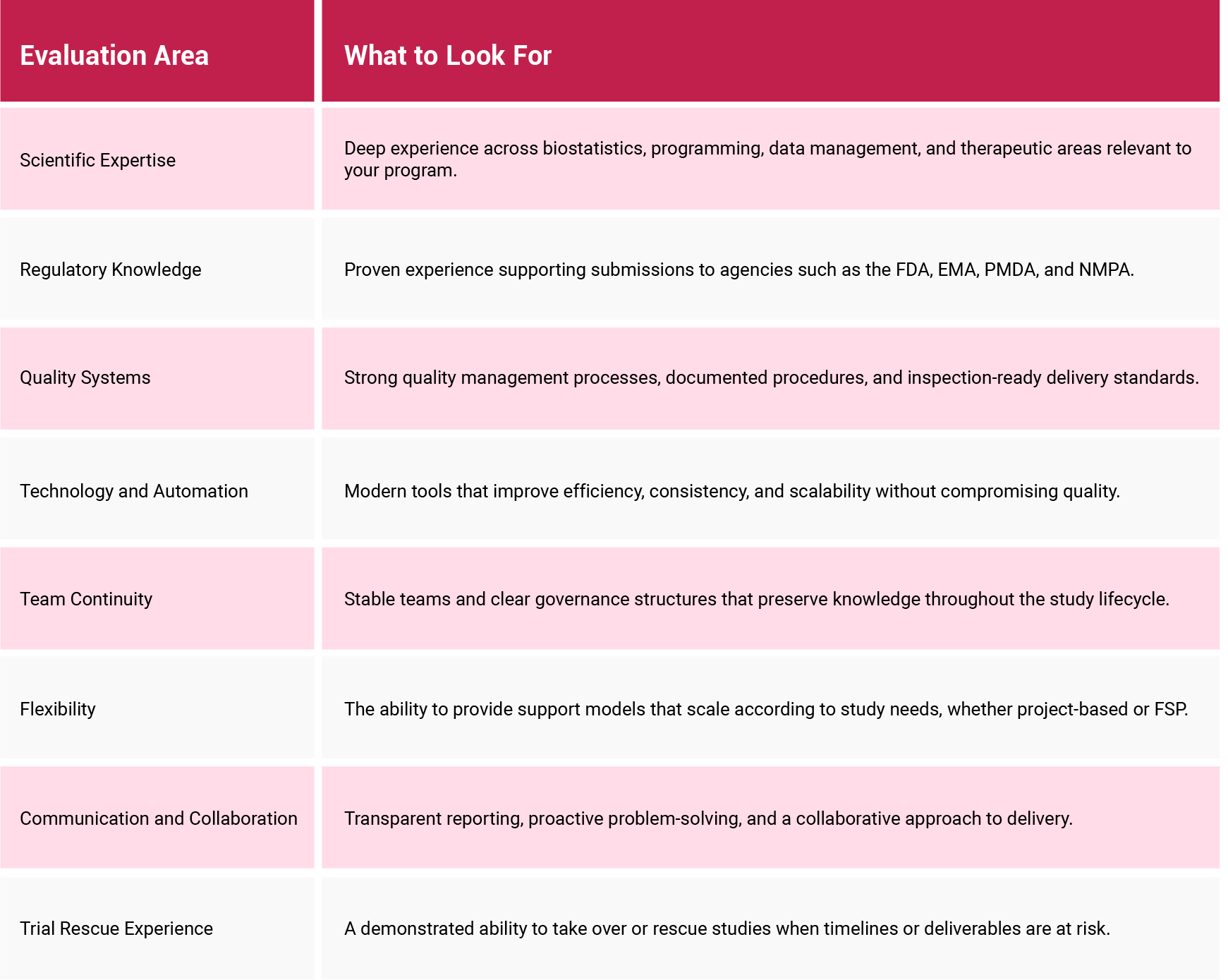
While technical capability is essential, sponsors should also consider how a provider works. Strong biometrics partnerships depend on clear communication, scientific leadership, and the ability to adapt to changing development priorities over time.
With deep scientific expertise, extensive regulatory experience, and a collaborative approach that integrates seamlessly with sponsor teams, we help organizations navigate complex clinical development challenges while maintaining the highest quality standards.